


Role
Product Designer & UX Researcher.

Tools
Figma, Google Forms, Market Research, Gemini AI, Google Analysis, Adobe Creative Cloud.
Timeline
6 weeks
The Core Problem :
Dermatology is a privilege. Average wait times are 56 days in the U.S., while the skincare market is booming ($115.6B). People self-diagnose with misinformation from social media.
PROJECT OVERVIEW
Bridging the gap between beauty retail and medical safety.
Context
Dermatology has become a privilege, not a standard of care. With average wait times of 32 days in the US and patient-to-doctor ratios exceeding 200,000:1 in rural areas, millions are left to self-diagnose using social media, leading to damaged skin barriers and delayed detection of serious conditions.
Strategic value
Customers benefit from instant peace of mind and personalized routines. This initiative aligns with the need for Ethical AI, prioritizing patient safety over sales through our "1% Doubt Rule." Ultimately, we aimed to bridge the gap between beauty retail and medical care
Objectives
Our goal was to create a nuanced 3-Tier Triage System. We aimed to:
Automate cosmetic care (Low Risk).
Bridge the gap for chronic conditions with safe, supportive care while referring (Medium Risk).
Protect users from dangerous misdiagnosis (High Risk).
Results (simulated / reaserch)
Retention Up: "Medium Risk" users showed 70% intent to buy the "Safe/Supportive" routine while waiting for their doctor.
Safety: Zero active ingredients (acids/retinols) recommended for unverified conditions.
Trust: Users rated the "Yellow Alert" (Caution) flow as "Highly Responsible."
80 %days
Average Wait Time
It takes 35 days to see a dermatologist in major US metro areas; in rural areas, this can extend to 3-6 months.
$150 +
Consultation Cost
Out-of-pocket cost for a single visit, making skin health a financial privilege for many.
80 %
Misdiagnosis Rate
Of online self-diagnoses are incorrect, leading to damaged skin barrier and delayed treatment.
"Dermatology has become a privilege, not a standard of care "
Why do we need this ?
Cross-Functional Alignment
Medical & Design

"how do we treat without prescribing?
Result: The "supporive care" (cleanser / SPF only)
"Standard datasets are biased"
Result : integration of Monk Skin Tone Scale (MST) for inclusive computer vision.
Engineering & Ethics
Business & Legal
"we cannot promise a cure"
Result: "Not diagnostic device" guardrails and referral revenue model
Understanding the skincare landscape revealed why users struggle to trust AI-powered beauty tools
Secondary Research
54%
Consumers using AI virtual try-on (2025 study)
Understanding the skincare landscape revealed why users struggle to trust AI-powered beauty tools
29% fully / 31% trust w/ doubts
60%
Transparency + Privacy + Fairness
Consumers who use AI while shopping
Trust levels in AI beauty tools
Key drivers of consumer trust in beauty AI
Americans who say they trust what they see online less than ever, and 82% who want AI use clearly disclosed
75%
AI & Trust in Beauty
Primary Research
We conducted a deep-dive survey with Gen Z/Millennial users (Ages 20-30) to validate assumptions. The data revealed a cohort that is overwhelmed, inconsistent, and skeptical.
83.3%
The majority of participants validated the "Dead Stock" problem

Frustration and Overwhelm: Users are overwhelmed by choices, spend a lot without seeing results, and suffer irritation from new products.
66.7%
The Need for Medical Validation: To trust AI, 66.7% of users demand a "Dermatologist Approved" seal.
(Qualitative Validation )

"I spend too much money on products that don't work or irritate my skin because I don't know my real skin type."
Paula James
Customer First, Customer Goals

"I don't trust a robot to diagnose me unless a doctor validates it. I need scientific proof, not just magic."
Camila Maclean

"I can't afford a $200 consultation plus $150 in products. I need a solution that fits my real life."
Patricia Hernandez

“It takes too long for me to get a consultation with a dermatologist, and most of the time I only see referrals on social media.”
Mario Lituma
Based on primary research (N=20) identifying key user frustrations.
PAIN POINTS
- Overwhelmed by choices (Analysis Paralysis)
- Skin irritation from wrong products.
Cannot affort a $200 dermatologist visit.
"I spend too much money on products that don't work or irritate my skin because I don't know my real skin type. I need science, not magic."
Customer First: Estefania's Journey
Estefania Inurritegui
GOALS
- Clear, scientific guidance.
- A routine that fits a student budget.
-Instant reassurance for flare-ups.
PAIN POINT
Lack of AI transparency
Users feel they are getting a "buy this " product without understanding why
OPPORTUNITY
Explainable AI
Visual evidence overlay. Show the user "What " the AI sees (reddness, texture maps , etc)
PAIN POINT
Skin Tone Bias
Standard AI falls on darker skin tones, leading to distrust.
OPPORTUNITY
Monk Scale (MST)
Train on Fitzpatrick I-IV to ensure user is seen and supported .
PAIN POINT
Wait Times
Long delays anxiety and "panic buying" of wrong products.
OPPORTUNITY
Async Triage
Instant "Middle Risk" protocols to manage care while waiting for a doctor.
PAIN POINT
Unverified Content
Influencers driving bad medical advice
OPPORTUNITY
Derm- Validated
Dermatologists decide. AI assists
From Pain Points to Design Opportunities
SYNTHESIS & STRATEGY
Project Tactics
High-Low Budgeting
Integrated a strict exclusion logic. If the AI detects any marker of irregularity with >1% uncertainty, the app locks the marketplace, prioritizing safety over sales
The "While You Wait" Protocol
The "1% Doubt" Rule
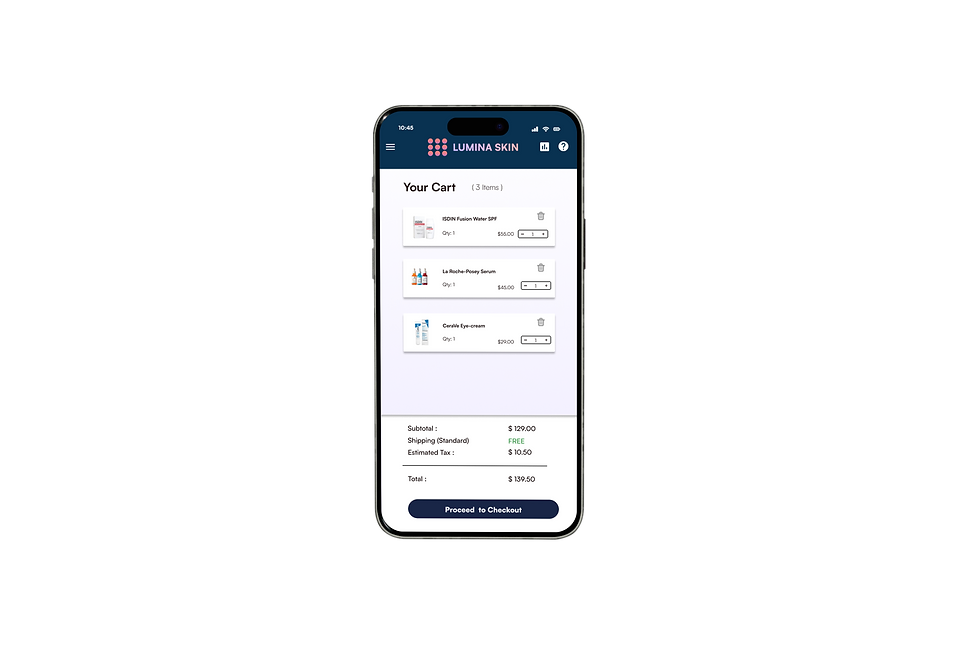
For Middle Risk users (e.g., severe acne) waiting for appointments, we restricted the shop to "Supportive Care" only (Cleanser + SPF), preventing damage from harsh actives.
Developed a recommendation engine that mixes high-performance serums with affordable basics, respecting the user's financial reality rather than pushing a full expensive brand line.

THE CORE ENGINE- "1% DOUBT TRIAGE ARCHITECTURE
The 1% doubt rule
The "1% Doubt" Safety Protocol: Integrated a strict exclusion logic. If the AI detects any marker of irregularity (irregular mole, infection) with >1% uncertainty, the app locks the marketplace, preventing the user from buying cosmetic products that could be harmful.
Low Risk (80% of cases)
High Risk (Danger): Marketplace Locked.
Full Marketplace Access. (Treats: Dryness, Mild Aging).
No products sold. Immediate priority referral generated. (Flags: Irregular Moles, Infections).
Medium Risk (Chronic/Complex): Restricted Marketplace.
The AI blocks harsh actives but allows the purchase of "Supportive Care" (Gentle Cleanser + SPF) and flags a non-urgent referral. (Treats: Severe Acne, Rosacea).

Design Concepts
Visualizing the 3-Tier Triage Logic. The interface adapts its color palette and available actions based on the AI's risk assessment.


Designing the data intake
Before the AI can work, it needs context. The architecture requires building a "digital twin" of the user's skin profile to ensure recommendations are safe and relevant.


Final mockups scan & analysis


Green path (Low risk)


Yellow path (Medium risk)


Red path (High risk)


Global Innovation, Local Impact
Lumina Skin Lab was developed with a primary focus on the United States market. This was intentional. The U.S. provides the ideal infrastructure to analyze what works at scale in digital health.
Key Learnings from U.S. Market:
-
We learned which UX and AI patterns users trust implicitly.
-
How to integrate professionals into the loop.
-
Regulatory guardrails for safe AI healthcare.
The Long-Term Goal
Adapt these proven methods to Peru and Latin America, where dermatologist access is severely limited. Lumina is designed globally to democratize care locally.
USA
LATAM

